Guide · Updated June 2026
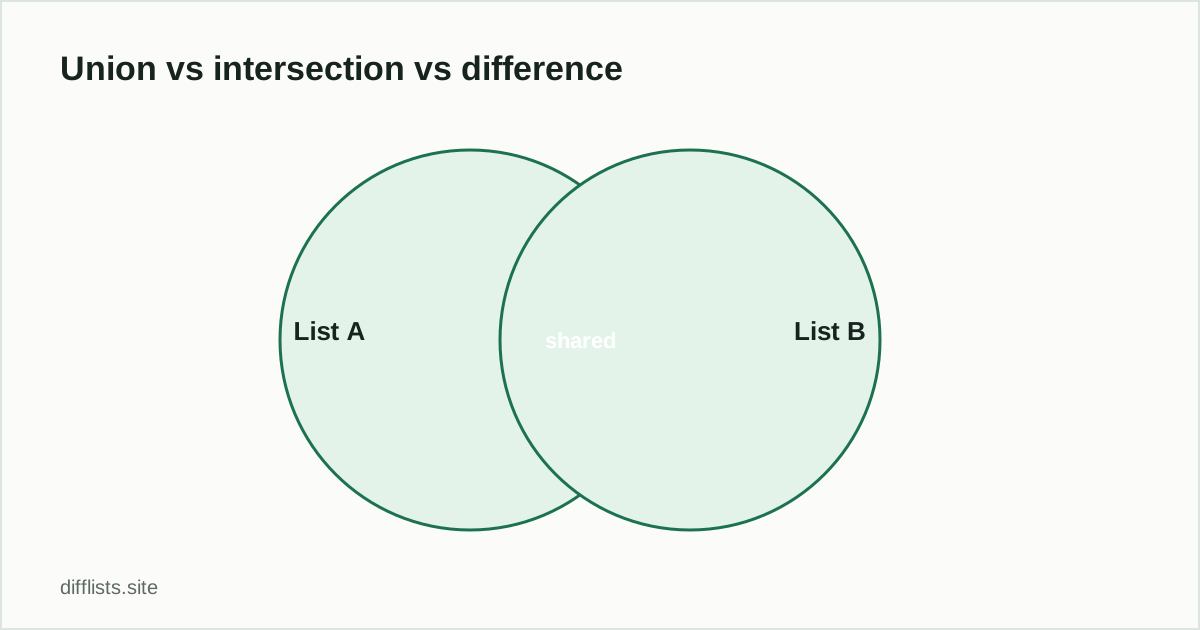
Set operations sound academic, but they describe something you already do by hand when you scan two lists for matches. Here’s what each one means, using two small example lists:
List A: Kyoto, Lisbon, Oslo, Reykjavik, Tallinn
List B: Lisbon, Oslo, Vienna, Zagreb
Difference (A − B)
Items in A that don’t appear in B: Kyoto, Reykjavik, Tallinn. This is the one people ask for most — “what’s missing from the second list?”
Intersection (A ∩ B)
Items present in both lists: Lisbon, Oslo. Useful for finding confirmed matches — subscribers on two mailing lists, records that exist in both systems, or duplicate entries between sources.
Union (A ∪ B)
Every distinct item from either list, with duplicates removed: Kyoto, Lisbon, Oslo, Reykjavik, Tallinn, Vienna, Zagreb. This is your combined master list.
Symmetric difference (A Δ B)
Everything that appears in exactly one list, but not both: Kyoto, Reykjavik, Tallinn, Vienna, Zagreb. It’s the union minus the intersection — the complete change set between two versions of a list.
Which one do you actually need?
- Checking what changed since last time? Start with symmetric difference.
- Reconciling two customer exports? Use intersection for confirmed matches and the two differences for outliers on each side.
- Building one clean master list from two sources? That’s a union, usually followed by de-duplication.
Set notation and symbols
| Symbol | Name | Meaning |
|---|---|---|
| A ∪ B | Union | Everything in A, B, or both |
| A ∩ B | Intersection | Only what A and B share |
| A − B (or A \ B) | Difference | What’s in A but not B |
| A △ B | Symmetric difference | Everything except what A and B share |
| A′ (or Aᶜ) | Complement | Everything not in A |
The complement is the one operation on this list that doesn’t involve a second list at all — it asks “what’s the opposite of A” relative to some larger universal set, rather than comparing A against a second list B. A practical example: if A is “customers who opened the email,” the complement of A (within “everyone the email was sent to”) is everyone who didn’t open it.
Union and intersection in probability
The same two operations show up constantly in probability and statistics, just written as P(A ∪ B) and P(A ∩ B) instead of applied to lists:
- P(A ∪ B) — the probability that event A happens, event B happens, or both happen.
- P(A ∩ B) — the probability that both A and B happen at the same time.
The underlying idea is identical to the list version: union widens out to “either,” intersection narrows down to “both.” If you can picture two overlapping circles for two lists, you can picture the same two circles for two events — the math doesn’t change, only the thing being counted does.
See all five results for your own lists.
Open the calculatorFrequently asked questions
What is union vs intersection?
Union is every distinct item across both lists combined. Intersection is only the items that appear in both lists.
What is intersect vs union?
Intersect (intersection) narrows down to shared items only; union widens out to every item from either list, with duplicates removed.
Is symmetric difference the same as union minus intersection?
Yes. Symmetric difference equals the union of two lists with the shared (intersection) items removed.
Which operation should I use to find what changed?
Use symmetric difference — it captures every item that appears in exactly one of the two lists, which is exactly what changed.
Do these terms apply outside math class?
Yes. Reconciling exports, checking follower lists, and comparing spreadsheet columns are all everyday uses of union, intersection, and difference.
What are the symbols for union and intersection?
∪ (a U shape) means union, ∩ (an upside-down U) means intersection, − or \ means difference, and △ means symmetric difference.
What is the complement of a set?
The complement of set A is everything in the universal set that is NOT in A — the opposite of A rather than a comparison against a second set.
How are union and intersection used in probability?
P(A ∪ B) is the probability that event A or event B (or both) happens; P(A ∩ B) is the probability that both A and B happen at the same time.